
.jpg)
On 17 July 2026, the European Commission published a proposal for the revision of the EU Emissions Trading System (EU ETS). This revision represents a significant policy development for e‑NG and e‑LNG in the European Union. While much of the public debate has focused on carbon pricing and industrial competitiveness, the proposal also introduces a range of new funding mechanisms, support schemes, and carbon accounting rules that could substantially improve the business case for e-NG and e-LNG.
This proposal forms part of a wider package that also amends FuelEU Maritime (the EU regulation on the use of renewable and low-carbon fuels in maritime transport)and the maritime MRV Regulation[i] (the EU regulation governing the monitoring, reporting and verification of greenhouse gas emissions from maritime transport), revises free-allocation benchmark values[ii] and is accompanied by an impact assessment[iii].
Overall, the FuelEUMaritime changes are largely administrative: they streamline and merge the EU ETS and FuelEU monitoring and reporting into a single system rather than altering the fuel-intensity targets that drive demand for renewable fuels.
A key development for e‑LNG is the creation of the Sustainable Maritime Alternative Propulsion (SMAP) mechanism under proposed Article 3gaa. For the first time, the EU would establish a dedicated support scheme for sustainable maritime fuels (SMFs).
The Article defines SMFs broadly. It covers biogas and advanced biofuels, renewable fuels of non-biological origin(RFNBOs/synthetic fuels), and low-carbon hydrogen and low-carbon fuels, provided they qualify for a zero-emission factor under the ETS rules. This means that RFNBO-based fuels such as e‑NG and e‑LNG could benefit from the mechanism if they meet the relevant Renewable Energy Directive (RED) III and ETS accounting requirements.
The SMAP mechanism would reserve up to 110 million ETS allowances until 2040 to support the deployment of SMFs. The level of support is tiered by fuel type: it can cover up to 90% of the remaining price difference for RFNBOs (such as e-NG and e-LNG), 80% for low-carbon hydrogen and low-carbon fuels, and 55% for biogas and advanced biofuels, in each case where the fuel qualifies for a zero-emission factor. These base rates can rise by up to a further 15% point through the feedstock-origin and island-voyage bonuses described below. However, to qualify for it, SMFs must be produced either in the EU or an eligible third country linked to the mechanism.
Additional support may be available in two cases. First, the proposed Article 3gaa provides a possible 10%-point increase where the relevant feedstocks originate in the EU or are eligible for third countries. Secondly, a further 5%-point increase of support may be available on voyages between an EU mainland port and an EU island port for which ETS allowances must be surrendered. However, it is important to note that support is not automatic: shipping companies may apply on a yearly basis, and if demand exceeds the allowances available in a given year, allocations are reduced pro-rata across all applicants. Overall, much of the operational detail, reference prices, the calculation of the price differential and safeguards against overcompensation is left to delegated and implementing acts that are still to be adopted.
In practice, this may address one of the biggest barriers for e‑LNG today: the significant cost gap between renewable and conventional marine fuels. As a result, when combined with the gradually tightening FuelEU Maritime requirements, it could become one of Europe’s strongest demand-side incentives for renewable maritime fuels.
Beyond maritime-specific support, the ETS revision introduces several other funding streams that could directly benefit e‑NG and e-LNG projects.
The revised InnovationFund (endowed with 200 million allowances) would explicitly support:
· Production of low‑ and zero‑carbon maritime fuels;
· Renewable energy technologies;
· Carbon capture, utilization and storage (CCUS);
· Direct air capture (DACCS);
· Infrastructure reducing maritime emissions.
For e‑NG developers, this means potential support not only for e-NG production facilities but also for hydrogen production, carbon capture systems, CO₂ transport infrastructure and fuel synthesis plants.
Starting in 2028, the proposed Industrial Decarbonization Bank (a proposed EU-level entity envisaged at around €100 billion) would provide support through:
· Capital investment grants;
· Operational expenditure support;
· Fixed carbon premiums;
· Carbon Contracts for Difference.
The Bank is designed to support the scale-up and deployment of industrial decarbonization technologies, processes, and techniques. Its funding would be made available in two phases:
· Phase 1: 400 million allowances between 2028 and 2030;
· Phase 2: a further 400million allowances between 2031 and 2040.
Because e‑NG projects often face high upfront capital expenditure and significant early operating costs, these instruments could help bridge the gap between pilot projects and commercial deployment.
The proposed expansion of the Modernization Fund further strengthens support for:
· Renewable energy generation including biogas and biomethane;
· Hydrogen infrastructure;
· CO₂ infrastructure;
· CCS and CCU projects;
· Industrial decarbonization investments.
The Modernization Fund is limited to eligible beneficiary Member States whose GDP per capita was below 75% of the EU average over the 2022-2024 period. As a result, these funding opportunities would primarily support project development in Member States with greater investment needs to finance the energy transition. For e‑NG and e‑LNG projects, this could be particularly relevant where access to renewable electricity, hydrogen infrastructure, CO₂ transport networks or industrial decarbonization funding remains less developed, but where targeted EU support could help unlock new project pipelines.
The proposal would require Member States to allocate at least 50% of their ETS revenues to support the decarbonization of ETS-covered sectors, including maritime transport. For the maritime sector, priority measures include sustainable alternative fuels such as renewable hydrogen and ammonia, as well as innovative technologies and supporting infrastructure. More broadly, Article 10(3) also identifies industrial decarbonization, clean industrial production technologies, CCUS and the development of CO₂ transport networks as eligible priorities.
Together with the 110 million allowances earmarked for the SMAP mechanism, this creates an additional national funding channel for projects that can contribute to maritime and industrial decarbonization.
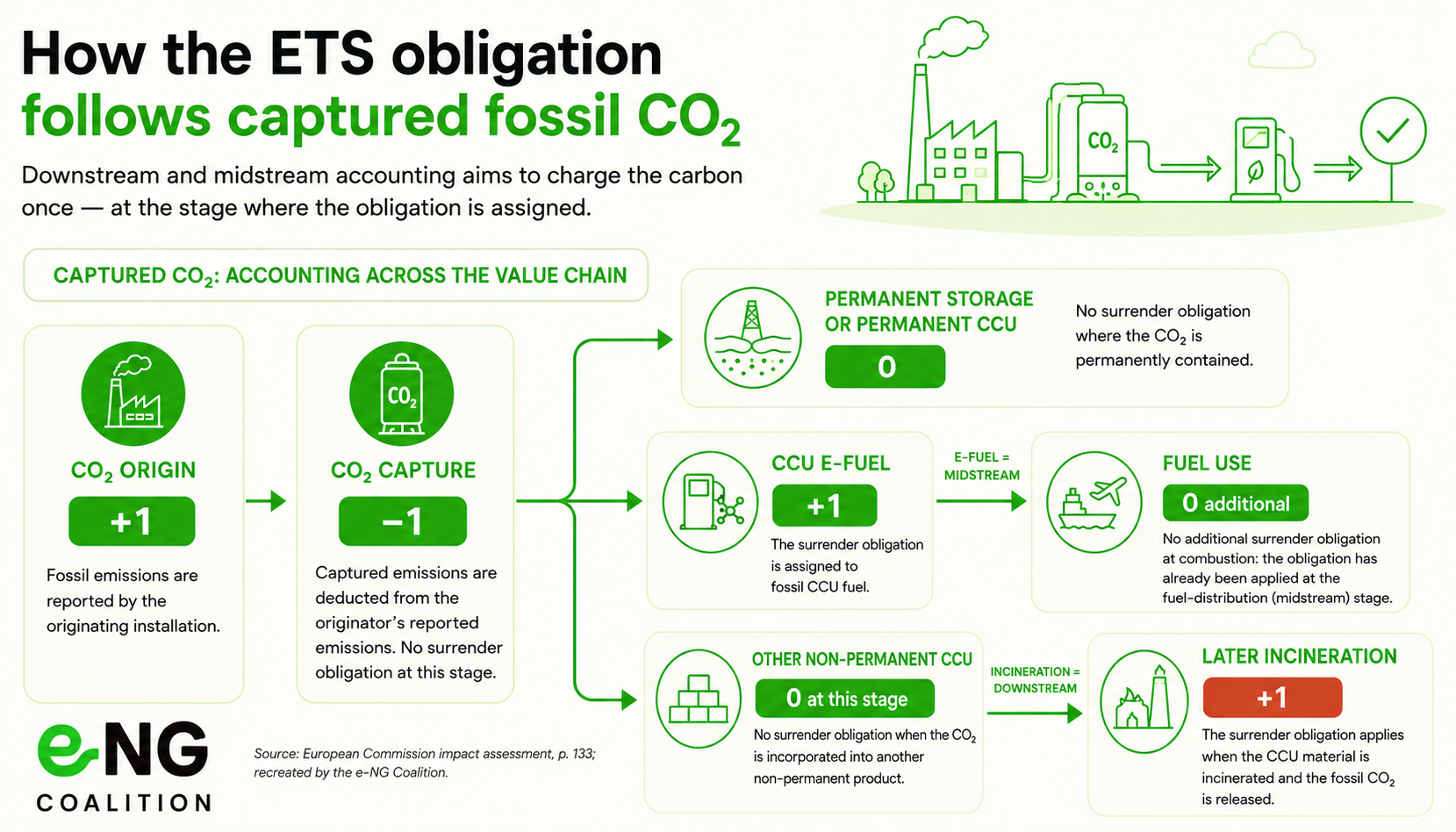
Another important update brought by the proposal relates to the treatment of captured CO₂ within the ETS. The revision moves away from a purely upstream accounting model, under which captured CO₂ is largely treated as emitted at the point of capture, towards a hybrid downstream and midstream approach that better accommodates CCU pathways.
Under the revised rules, ETS surrender obligations would no longer automatically arise when captured CO₂is incorporated into certain products. Instead, obligations may be deferred where the carbon is either permanently chemically bound or expected to be re-emitted through activities already covered by the ETS. This shifts the accounting point further along the value chain and aligns ETS treatment more closely with the actual treatment of carbon.
The proposal introduces a new accounting approach for captured CO₂ used in the production of synthetic fuels, a category that includes RFNBOs and low-carbon fuels. Carbon chemically bound in synthetic fuels would be considered emitted at the point of fuel distribution, rather than at the point of capture or final combustion, effectively establishing a midstream accounting approach. The Commission would be empowered to establish detailed implementing rules governing the tracking of captured CO₂ streams, the treatment of mixed carbon sources and the avoidance of double counting.
The proposal already brings certain categories of smaller ships (below 5,000 GT but not below 400GT) into the scope of the EU ETS through an amended Annex I, with the overall cap increased accordingly. This immediately expands the number of vessels subject to ETS obligations, and therefore the addressable market for e-NG and other renewable maritime fuels. In addition, the proposal requires the Commission to assess the feasibility and the economic, environmental, and social impacts of further extending coverage to ro-pax and passenger ships below 5,000 GT, and to report on its findings by 31 December 2031.
Otherwise, the proposal maintains the current maritime ETS architecture under Article 3ga:
· 100% coverage of intra-EU voyages.
· 50% coverage of extra-EU voyages.
The proposal also strengthens anti-circumvention rules for neighboring container transshipment ports by lowering the eligibility threshold from 65% to 50%, introducing additional infrastructure-based criteria, and updating the list annually (vs every 2 years). This aims to limit rerouting through nearby non-EU ports to avoid ETS obligations and maintain the effectiveness of the maritime ETS.
The proposal also maintains requirements for the Commission to assess coherence between the EUETS and future IMO climate measures, including ways to avoid double payment and double burden for shipping companies (Article 3gg). This is particularly relevant for e-NG/e-LNG because the competitiveness of renewable maritime fuels will increasingly depend on how the EU ETS, FuelEU Maritime and future IMO measures interact. A clear and predictable framework will be important for maintaining investment certainty in alternative fuels.
This will become increasingly important as international regulations evolve. For e‑LNG developers, investment decisions will depend not only on FuelEU Maritime or the EU ETS in isolation, but on how European and international frameworks interact. Greater alignment could strengthen compliance value for renewable maritime fuels and improve investment certainty.
The proposal introduces an “ETS as a Service” mechanism under which the EU could support third countries to establish emissions trading systems for maritime transport. As mentioned above, today, the EU ETS only covers 50% of emissions from voyages between an EU port and a non-EU port. Under Article 25b, a participating third country could apply carbon pricing to the remaining 50% of those emissions that currently fall outside EU ETS coverage. Where maritime emissions are priced under this mechanism, the third country would benefit from revenues generated from the remaining 50% of emissions that currently fall outside the scope of Article 3ga.
While less directly relevant to e-NG and RFNBO deployment, several broader ETS reforms could have indirect implications for the sector:
· Conditional free allocation (Articles 10a(3b)-10a(3e)): From 2031, installations receiving free allowances will be required to submit an Invest in EU Decarbonization Plan. ~80% of free allocation will be granted upon approval of the plan, with the remaining 20% linked to the implementation of investments and achievement of emissions reductions.
· Carbon removals (Article9c and Article 14(1a)):The proposal integrates domestic permanent carbon removals into the ETS framework through a dedicated reserve of 250 million allowances (+ an additional contingency reserve of 10 million allowances) to support BioCCS and DACCS between 2031 and 2040. In addition, Article 14(1a) would allow shipping companies to compensate for part of their fossil emissions using certified domestic permanent carbon removal units generated from the storage of biogenic emissions under the CRCF Regulation. Carbon removals can thus become a competing decarbonization pathway against e-NG.
· International credits (Article 9b):The proposal introduces a mechanism (up to 260 million allowances, funding up to 260 Mt of high-quality, high-integrity international credits over 2036 to2040) allowing the EU to use international credits to contribute towards its climate ambition. This is contingent on a 2033 Commission assessment of credit-market integrity and availability; if suitable credits are not available, the post-2035 linear reduction factor reverts to 2.7%.
The maritime sector is increasingly positioned to benefit from renewable LNG solutions.
One of the key advantages of e‑LNG is that it does not require a completely new bunkering ecosystem. Unlike some alternative marine fuels, e‑LNG can utilize existing LNG infrastructure, storage facilities, bunkering assets, and vessel technology. This means renewable methane can be deployed through an already established global fuel supply chain, reducing investment risk and accelerating market uptake.
The 2026 International Gas Union (IGU) World LNG Report records an active global LNG fleet of 804 LNG vessels at the end of 2025, while the industry continues to add new LNG-powered ships and bunkering capacity, with 301 vessels on the orderbook at the end of 2025. Rather than requiring fleet replacement, e‑LNG offers a route to progressively decarbonize vessels that are already operating or currently being delivered.
The compatibility of e‑LNG with existing infrastructure makes it a practical "drop‑in" solution for shipowners. As regulatory pressure increases under FuelEU Maritime, the EU ETS and future IMO measures, the ability to decarbonize existing LNG vessels through renewable drop‑in fuels could become an attractive compliance pathway without fundamentally redesigning vessels or fuel supply systems.
While the package contains numerous positive elements, it is not without challenges.
The proposal weakens some of the mechanisms underpinning long-term carbon price formation, including:
· A lower post‑2030 Linear Reduction Factor (Article 9);
· Less stringent Market Stability Reserve rules.
While intended to provide additional flexibility and reduce overall compliance costs, some stakeholders argue these changes could reduce allowance scarcity and weaken future ETS carbon prices. For renewable fuels, including e‑NG and e‑LNG, a weaker carbon price signal could reduce the economic incentive to switch away from fossil alternatives.
From an e‑NG and e‑LNG perspective, the ETS revision is broadly positive.
The combination of dedicated support for SMFs, expanded access to ETS-funded financing, clearer treatment of RFNBOs, and stronger recognition of CCU pathways represents a significant step forward.
As the legislative process moves forward, the final details will matter. But if the key elements are retained, the ETS revision could become a consequential policy package for the future development of e-NG in Europe. The proposals now enter the ordinary legislative procedure. If both the European Parliament and the Council of the EU adopt their negotiating positions by the end of the year, trilogue negotiations could begin in early 2027, though, given the breadth of the file and the ordinary legislative procedure, a provisional agreement is more likely later in 2027 or in 2028.
For the e‑NG sector, the proposal sends a broader signal: the EU increasingly recognizes that decarbonization will require not only direct electrification and hydrogen, but also scalable renewable fuels capable of leveraging existing infrastructure and serving hard-to-abate sectors such as maritime transport.
[i] COM(2026)620)
[ii] (COM(2026) 619)
[iii] (SWD(2026) 617)
------------------------------------------------------
For more information, please contact Alexandra Popova at alexandra.popova@eng-coalition.org
.jpg)
.jpg)
.jpg)