
.jpg)
Over the past month, the e-NG Coalition has been present at some of the most influential energy and decarbonization forums in Europe and Asia, signaling an important moment for our mission to accelerate the deployment of e-methane and ensure that regulatory, market, and technological pathways evolve in a coherent, ambitious direction.
Being invited to speak at these events is not only symbolic, but also highly strategic: it allows the Coalition to shape debates at the very moment when policies, markets, and investment decisions are being discussed and ensures that e-NG remains visible, credible, and firmly positioned as a cornerstone of Europe’s clean energy transition.
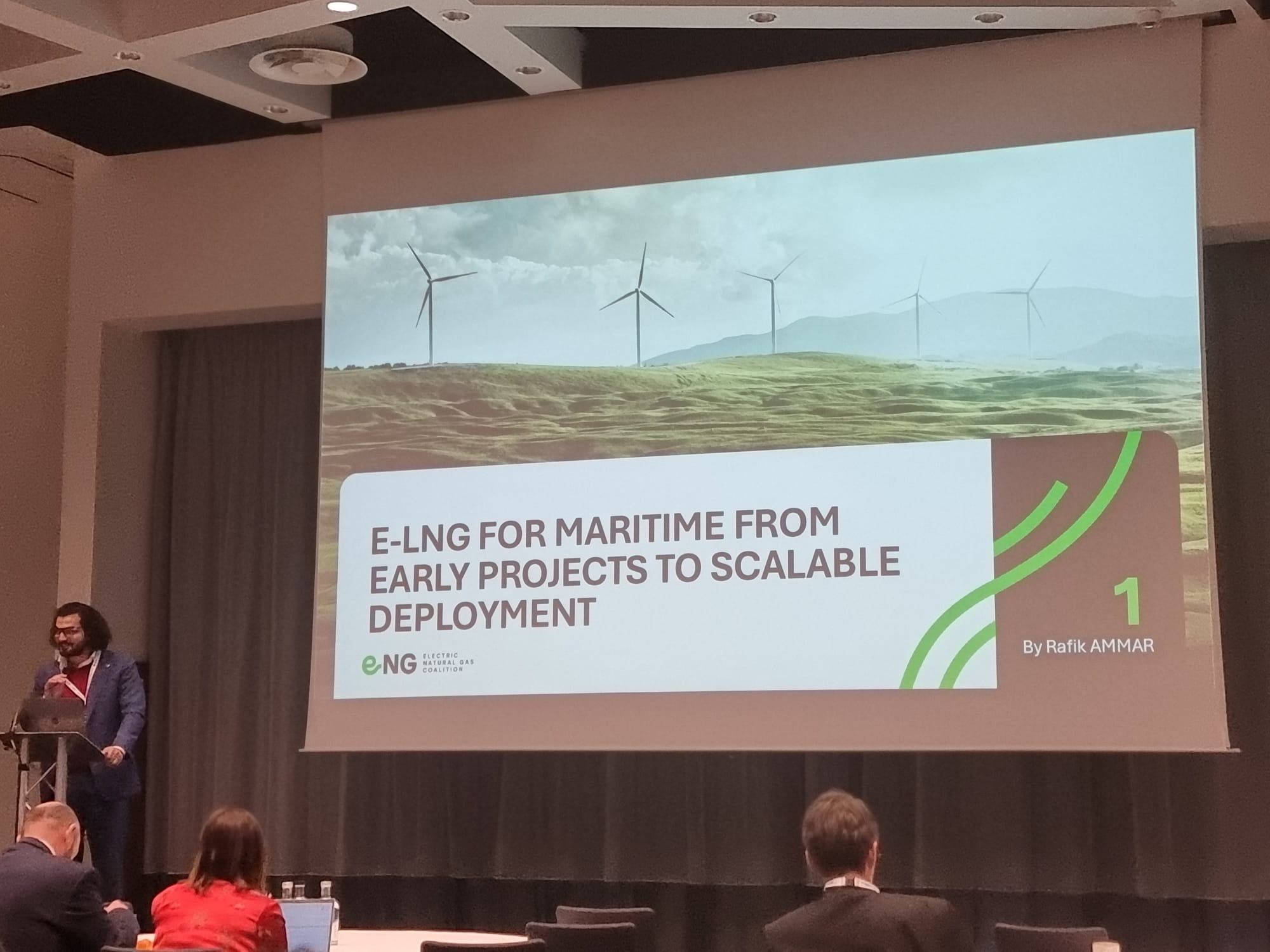
Held in Amsterdam, the Global Maritime Decarbonization Summit gathered the entire maritime value chain at a pivotal moment for the sector. With the IMO’s Net-Zero Framework still pending, the absence of global regulatory certainty has increased the risk of misaligned investments, making industry collaboration more critical than ever.
The summit addressed the viability of alternative marine fuels, compliance with FuelEU Maritime and the EU ETS, methane slip mitigation, and the infrastructure needed for low-carbon shipping.
Our Policy Director, Rafik Ammar, brought the Coalition’s perspective to these discussions, emphasizing the role of e-LNG and e-methane in providing scalable, credible pathways for maritime decarbonization. He also focused on the outcomes of the recent negotiations at the International Maritime Organization, including updates to the IMO Net Zero Framework after the last ISWG-GHG 21 and MEPC 84. His participation also reinforced the Coalition’s leadership in shaping fuel strategies that balance climate ambition with technological readiness and market stability.
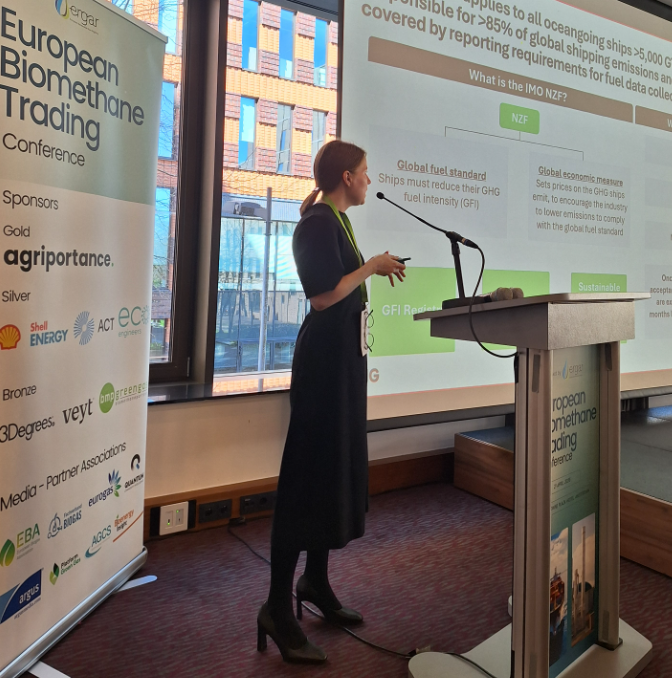
The European Biomethane Trading Conference convened producers, traders, off-takers, registries, and policymakers to examine the rapidly evolving biomethane market and the cross-border implications of Renewable Energy Directive (RED III) implementation across Member States.
Bringing together the full biomethane and renewable gas value chain, the event addressed market development, certification frameworks, cross-border trade, infrastructure integration, and the policy landscape shaping Europe’s renewable gas sector.
The Coalition's participation offered a timely opportunity to advance discussions on the growing convergence between biomethane, RFNBOs, and synthetic methane pathways. As Europe scales renewable gas deployment, ensuring that e-NG is embedded in conversations on market design and infrastructure compatibility remains a core advocacy priority.
Our Policy Officer, Alexandra Popova, represented the e-NG Coalition in this dialogue, contributing to the panel on maritime decarbonization. She focused on recent developments at the International Maritime Organization, including updates to the IMO Net Zero Framework ahead of ISWG-GHG 21 and MEPC 84, as well as implications of the FuelEU Maritime regulation for renewable fuels.
.jpeg)
REM Asia 2026 is one of the Asia-Pacific region's foremost gatherings on clean energy markets, bringing together a diverse mix of corporate energy buyers, utilities, project developers, certification bodies, and regulators from Southeast Asia, Japan, South Korea, China, and Singapore, navigating the next phase of their energy transitions.
Agenda topics ranged from renewable electricity procurement and energy attribute certificates to lifecycle emissions accounting, traceability systems, and the investment conditions required to scale low-carbon technologies across complex global supply chains.
For the e-NG Coalition, the conference presented a valuable platform to demonstrate the growing relevance of synthetic methane in international clean energy debates. Questions of certification, additionality, and cross-border market integration, have been central fuel markets, and e-methane is increasingly part of that conversation. Rafik Ammar, representing the Coalition, engaged directly with industry and policy stakeholders to make the case for e-NG as a scalable decarbonization pathway in Asia.
While in Singapore, the Coalition also attended the French-Singaporean Maritime Roundtable on the 22 April 2026, hosted by the French Chamber of Commerce in Singapore as part of Singapore Maritime Week 2026 (20-24 April). The high-level event drew over 200 maritime leaders from France, Singapore, and the wider region, with panel discussions covering alternative fuels, investment strategies, port decarbonization, and the role of innovation in accelerating the sector's net-zero transition, themes closely aligned with the Coalition's own advocacy on e-methane as a viable maritime fuel pathway.
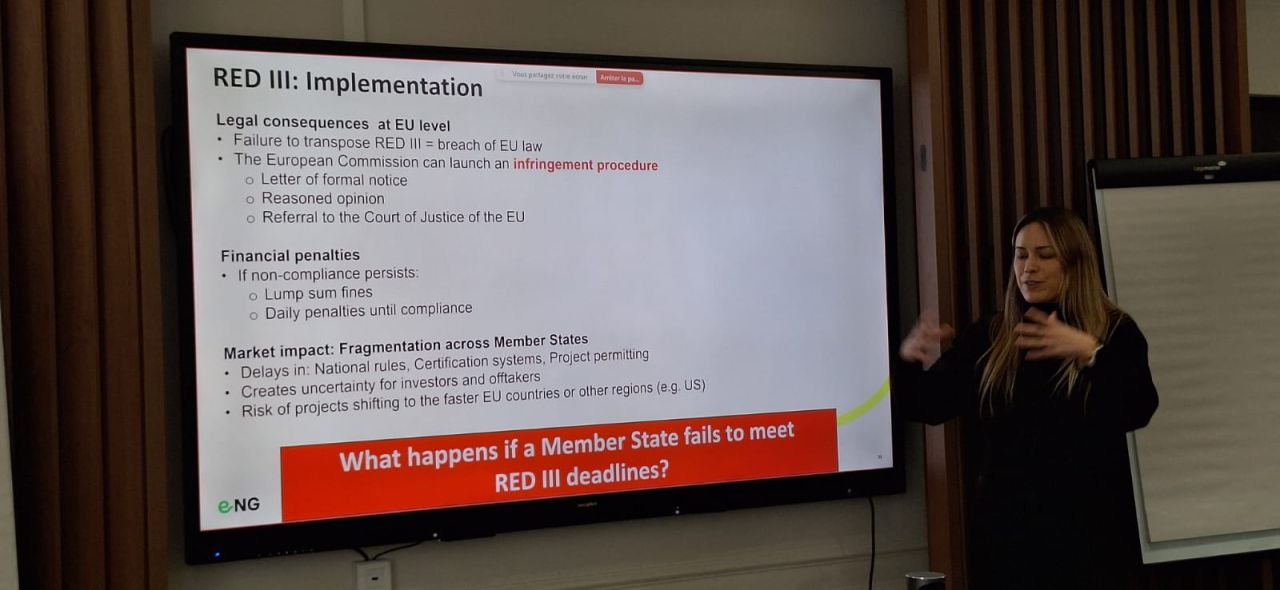
In Paris, the ATEE Power to Gas Club convened France’s key experts and stakeholders working across hydrogen, renewable gases, synthetic fuels, and energy system integration to exchange perspectives on the future of the sector and the evolving European regulatory framework.
During the event, our Communications Officer, Mariana Tostes, presented the implementation of RED III in Europe, with a particular focus on the transport sector and its implications for the e-methane market. The intervention highlighted how evolving European legislation is expected to shape demand for renewable fuels of non-biological origin (RFNBOs), as well as the importance of creating stable and coherent regulatory frameworks capable of supporting long-term investment and market development for e-NG.
Participation in technical and collaborative forums is particularly valuable for strengthening cross-sector dialogue and maintaining close engagement with the rapidly evolving renewable gas ecosystem. These settings bring together the full spectrum of stakeholders, from regulators and grid operators to project developers and financiers, creating space for the kind of substantive, working-level exchange that formal consultation processes rarely allow. Beyond knowledge-sharing, they offer an opportunity to build sustained relationships between industry, policymakers, and technology providers that are essential to driving progress toward shared decarbonization objectives.
Across all three events, the Coalition's presence served a clear purpose: to ensure that e-NG is understood, recognized, and embedded in Europe’s decarbonization strategies. Effective advocacy is not merely about visibility, but also about influence. Shaping how renewable gas markets develop, how certification frameworks are designed, and how infrastructure investment decisions are made requires consistent, informed engagement in the forums where these conversations happen.
By participating directly alongside policymakers, industry leaders, and technical experts, the Coalition works to:
At the same time, what is being discussed in the EU today will not remain confined to Europe. The regulatory frameworks, certification systems, sustainability criteria, and market mechanisms introduced here are likely to shape global investment trends, infrastructure planning, international trade flows, and fuel qualification standards far beyond the continent. Much like previous European energy and climate policies, these decisions have the potential to become reference points that influence how governments, industries, and financial institutions approach renewable fuels worldwide.
For sectors such as shipping, heavy industry, and global energy trade, which are inherently international, the implications are particularly significant because trends developed in Europe can have a direct impact across multiple regions. In this context, ensuring that e-NG is represented in these conversations is not simply a matter of visibility, but also about helping shape the path for renewable molecules globally for decades to come.
As expectations rise and implementation of not only key EU legislation, but also US, Canada, and Japan moves forward, these engagements reaffirm the Coalition's role as a trusted, technically credible voice in shaping the future of renewable and low-carbon molecules, and in ensuring that e-NG is not an afterthought, but central to the world’s clean energy architecture.
.jpg)
.jpg)
.jpg)