
.jpg)
From Annexes V and VI of the Renewable Energy Directive to the Implementing Regulation 2022/996
The European Commission (Commission) is currently preparing a revision of Implementing Regulation 2022/996 (IR996), which sets detailed rules for sustainability certification, greenhouse gas (GHG) accounting, and the operation of the Union Database (UDB) under the Renewable Energy Directive (RED). The revision is expected to address several outstanding implementation issues linked to renewable gaseous fuels, including the treatment of liquefaction pathways, the functioning of interconnected gas infrastructure and the practical application of mass-balance rules across the renewable gas value chain. A public consultation on the revised regulation is expected to open after the summer, currently anticipated for September 2026.
Alongside the revision of IR996, the Commission is reviewing Annexes V and VI of the RED. Under Article 31(5) of the RED, the Commission is required to periodically review the GHG accounting rules, methodologies and default values used for biofuels, bioliquids and biomass fuels and, where justified, revise existing values or introduce new production pathways. The review therefore represents a key opportunity to update the EU's methodology for calculating lifecycle GHG emissions, introduce clearer recognition of renewable fuels of non-biological origin (RFNBOs), including e-NG and e-LNG, in the EU framework, and ensure that the rules reflect technological developments and the latest scientific evidence.
Although the Annexes V and VI review focuses on biogases and biofuels, the methodological choices adopted now for biomethane and liquefied renewable gases are expected to set an important precedent for future RFNBO-based methane pathways and certification rules, including for e-NG and e-LNG.
Among other changes, the draft of Annexes V and VI introduces new pathways for gaseous renewable fuels, updated methane leakage assumptions, revised GHG accounting methodologies, and dedicated default values for compressed and liquefied biomethane. In particular, the draft proposes an additional default value of 4.9 gCO₂eq/MJ for liquefied biomethane and 2.4 gCO₂eq/MJ for compressed biomethane, alongside additional transport and distribution emissions where applicable.
As a reminder, the RED and the RFNBO Delegated Act 2023/1185 set out a standard methodology for calculating the GHG emissions intensity of renewable liquid and gaseous transport fuels of non-biological origin. Total emissions from the use of the fuel (E, in gCO₂eq/MJ fuel) are calculated as:
E = ei + ep + etd + eu – eccs
where ei covers emissions from the supply of inputs, ep covers emissions from processing, etd covers emissions from transport and distribution, eu covers emissions from combustion at end-use, and eccs accounts for emission savings from carbon capture and geological storage.
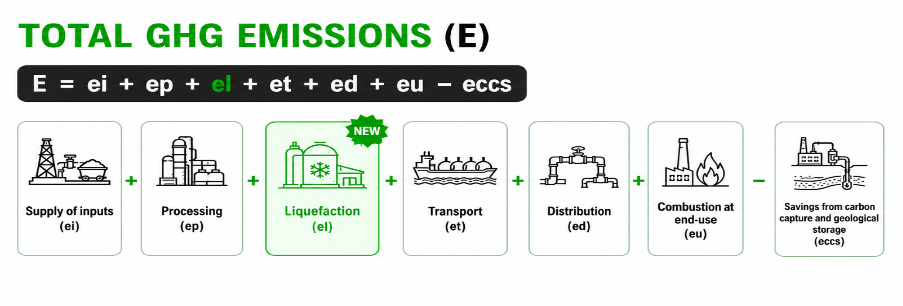
In a joint statement, the e-NG Coalition called on the Commission to apply the lowest possible default emission value, ideally zero, rather than the proposed 4.9 gCO₂eq/MJ liquefaction value, for liquefaction by equivalence pathways that rely on existing LNG infrastructure and do not require additional liquefaction energy input.
Additionally, in its response to the consultation, the e-NG Coalition highlighted the need to distinguish between different liquefaction pathways, including physical liquefaction, recondensed liquefaction and liquefaction by equivalence, and recommended that GHG accounting rules accurately reflect the actual energy consumed by each pathway.
But the debate on liquefaction by equivalence does not end with the revision of Annexes V and VI. If Annexes V and VI shape how the emissions associated with renewable methane are calculated, the upcoming revision of IR996 will determine how these volumes can be certified, traced and traded in practice. Consequently, the review of IR996 will be central to determining how liquefaction by equivalence is treated within the EU certification framework and whether the regulatory system fully recognizes the efficiencies and scalability benefits that this pathway can provide.
The following examples illustrate two pathways for liquefaction by equivalence. The first scenario relies on the mass-balance approach already applied within the EU today, where the sustainability characteristics of renewable gas injected into the European system can be allocated to LNG held within the same interconnected infrastructure (I. Liquefaction by Equivalence Through EU Mass-Balance Scenario). The second scenario assumes future integration of third countries into the UDB, allowing certified renewable volumes to be recognized across EU and non-EU jurisdictions, an integration that does not yet exist (II. Third-Country Integration Scenario).
This first scenario relies on the existing EU mass-balance system which enables renewable methane injected into the European gas system to be allocated to LNG located elsewhere within the interconnected infrastructure. Rather than physically transporting renewable molecules from the production site to a specific LNG terminal, the system relies on the transfer of sustainability attributes, allowing existing gas and LNG infrastructure to be used more efficiently while maintaining traceability of renewable volumes.
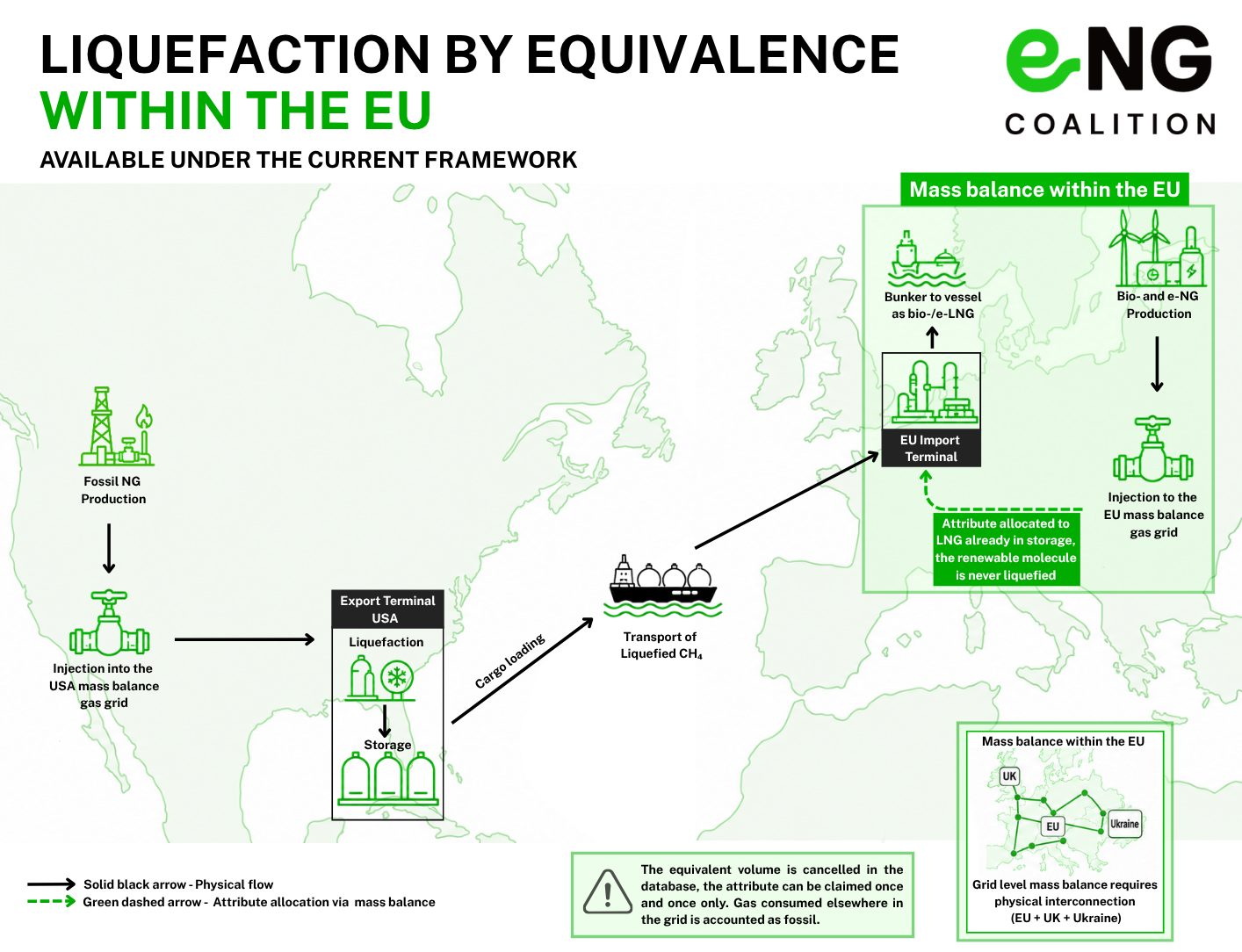
This LNG remains physically conventional LNG throughout the value chain.
N.B.: In some cases, renewable gas production sites are not directly connected to the transmission network. The gas may therefore first be transported by truck from the production site to a grid connection point before being injected into the interconnected system.
This is grounded in the existing framework. Implementing Regulation 2022/996 provides that where liquid or gaseous fuels are introduced into an interconnected infrastructure and subject to the same mass balancing system, the respective sustainability and GHG characteristics are assigned to the consignments entering and exiting that infrastructure which, per Article 2(18), includes LNG terminals. The allocation therefore takes place within a single, physically interconnected system.
The value of renewable methane lies not only in the physical molecule but also in its sustainability characteristics and GHG savings.
When renewable methane is injected into the European grid, these sustainability attributes are recorded and tracked through the mass-balance system. Through the EU mass-balance framework, the renewable attributes can be allocated to an equivalent quantity of LNG located within the interconnected infrastructure.
As a result, a vessel bunkering LNG in Rotterdam does not need to receive the exact renewable molecule produced in Finland. Instead, under the EU mass-balance system:
By way of illustration, filling a single bunker vessel via road transport would require in the order of several hundred truck deliveries at the quayside, with the attendant congestion, timing and safety constraints. For many dispersed renewable gas projects, physically moving every renewable molecule to a terminal for liquefaction would be operationally complex and costly. The mass-balance approach allows existing gas and LNG infrastructure to be used more efficiently, while ensuring that the quantity of renewable gas claimed does not exceed the quantity injected into the system.
It is equally important to underline what mass balance does not do. Nothing is created by the allocation. Where the renewable attribute is allocated to LNG supplied to a vessel, the corresponding volume is cancelled in the database so that it cannot be claimed a second time, and the gas physically consumed elsewhere in the interconnected system is accounted as conventional fossil gas. The attribute is moved once, and once only.
This second scenario assumes that third countries, such as the United States, are fully integrated into the UDB and that renewable gas certificates can be recognized and transferred between EU and non-EU jurisdictions under a common traceability framework.
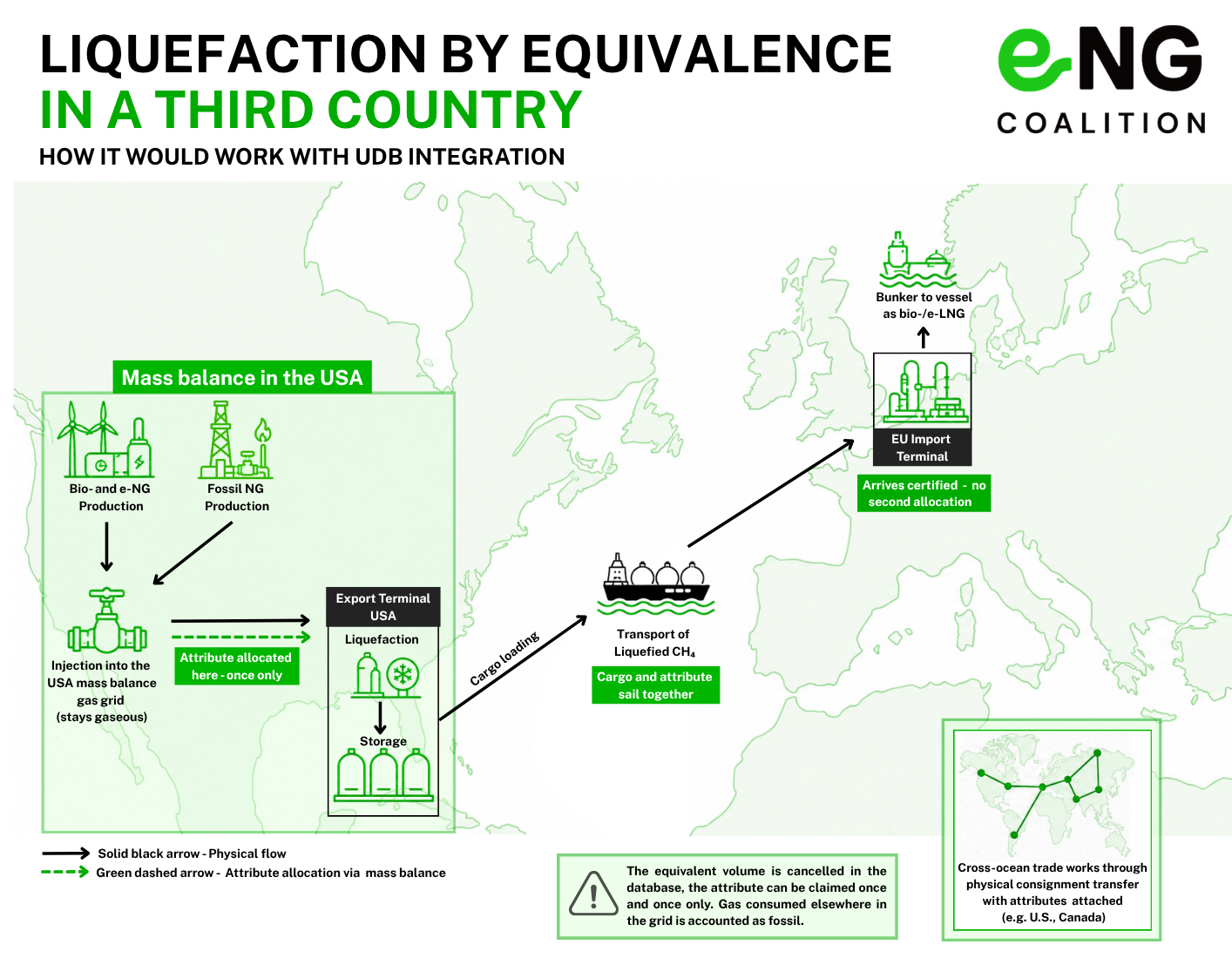
At the moment, the renewable gas is produced, a corresponding sustainability certificate is also created through the certification system. This certificate contains the renewable and GHG attributes associated with the renewable gas and is recorded in the relevant registry.
Assuming interoperability between a third-country registry and the UDB, these attributes could travel with the physical consignment and be recognized within the European certification framework. It is essential to underline that the attributes would not circulate independently: they would remain attached to the physical LNG cargo shipped from the third country to the EU, in the same way that sustainability characteristics travel with a consignment of biofuel today. The renewable attributes generated by a producer in the United States could therefore be claimed by an end-user in the EU only where a corresponding physical consignment has been delivered and the renewable volume has been certified, traced and accounted for within the mass-balance framework.
This is what distinguishes liquefaction by equivalence from book and claim. Under book and claim, an environmental attribute is sold entirely separately from any physical delivery, with no requirement for buyer and producer to be linked by a physical supply chain. Under mass balance, by contrast, the renewable molecule must be physically injected into, and physically present within, an interconnected system, and the attribute can only be claimed against a physical volume delivered out of that same system. Liquefaction by equivalence operates strictly within the second framework.
The integration of third countries into the UDB is a key prerequisite for this type of cross-border attribute transfer. It would effectively extend the EU mass-balance framework beyond the Union's borders and allow certified renewable gas produced in third countries to participate in the EU renewable gas market under a common traceability framework.
One further requirement should be noted for third country supply. Where bio-LNG is physically imported into the EU and stored within the interconnected gas infrastructure, the EU would oblige the economic operator to provide evidence of the physical biogenic origin of that bio-LNG, based on radiocarbon (C14) testing performed in accordance with Commission Delegated Regulation 2023/1640, with results uploaded to the UDB. While the objective of preventing fraud is legitimate, the practical implications are significant: the ongoing discussion within the EU does not specify testing frequency, applicable thresholds, or which laboratories would be recognized, and the cost falls at the production stage. For third-country exporters, this represents a material additional barrier that would benefit from clarification.
The regulatory treatment of liquefaction by equivalence matters for e-NG because carbon intensity (CI) assigned to renewable methane can determine whether it qualifies as an RFNBO under the RED. This, in turn, affects whether the fuel can count towards renewable energy targets and comply with regulations such as FuelEU Maritime.
As illustrated above, liquefaction by equivalence pathways rely on the transfer of sustainability attributes rather than the physical movement of renewable molecules themselves. In a mass-balance system, the renewable gas injected in the production site is not the same gas physically loaded onto a vessel at the LNG terminal; the vessel receives conventional LNG from the terminal while the renewable characteristics are allocated to it through the mass-balance system.
Liquefaction and transport, as physical processes, are undertaken on conventional natural gas, not on the renewable molecule to which the attributes are ultimately assigned. Under a mass-balance system, no renewable molecule is actually liquefied or shipped: the emissions associated with liquefaction and transport arise entirely within the conventional gas value chain and would occur regardless of whether any renewable attributes were allocated to that LNG.
The revision under discussion would nonetheless require these emissions to be added. Under the approach set out in the draft, the allocation of sustainability characteristics from renewable methane to LNG must take into account the additional GHG emissions generated in the process of liquefaction, which are added to the total emissions allocated to the resulting bio-LNG. Where the LNG was liquefied in a third country not connected to the Union's interconnected gas infrastructure, the emissions from transporting that LNG to the EU storage where the allocation takes place would be added as well.
This raises an important accounting question: should emissions associated with the physical liquefaction and transport of LNG be attributed to the renewable fuel when the renewable molecule did not physically undergo those processes?
Depending on the methodology applied, such an attribution can lead to the following additional accounted emissions:
Combined, these two emissions could add approximately 10-13 gCO₂eq/MJ to the CI of certain renewable LNG pathways like e-LNG and bio-LNG. This is an indicative range rather than a fixed value, since transport emissions vary by route.
This matters because, under the RED and the RFNBO Delegated Act, to qualify as an RFNBO, a fuel must achieve at least 70% GHG savings relative to the fossil fuel comparator of 94 gCO₂eq/MJ, corresponding to a maximum lifecycle CI of approximately 28.2 gCO₂eq/MJ.
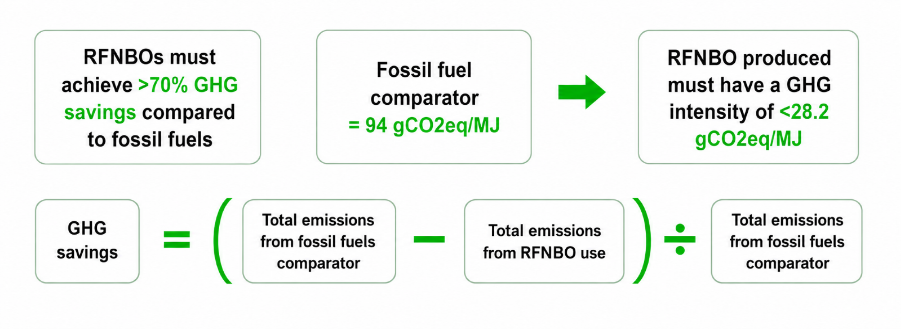
The CI assigned to e-NG and e-LNG pathways directly determines their compliance value. Even relatively small additional methodological changes in GHG accounting can have a significant effect on how attractive they are commercially. The significance of this depends on the starting point. A pathway with a baseline carbon intensity of around 18 gCO2eq/MJ1 sits below the threshold on its own merits; adding 10-13 gCO2eq/MJ for liquefaction and transport would push that same pathway above the 28.2 gCO2eq/MJ threshold. In other words, the additional attribution is decisive precisely for pathways that would otherwise qualify. Once this threshold is exceeded, the fuel no longer qualifies as an RFNBO under the RED and cannot contribute towards the renewable energy targets that depend on RFNBO status. The effect under FuelEU Maritime is different in nature but equally material, FuelEU sets a declining GHG intensity trajectory for energy used on board, so a higher CI does not disqualify a fuel outright but directly reduces the compliance value it delivers. In both cases the commercial consequence is the same: the additional attribution erodes the regulatory value of the fuel. As a result, a fuel that is renewable in every physical and technical sense could become ineligible for compliance purposes solely because of how liquefaction and transport emissions are attributed within the accounting framework.
For e-NG developers and investors, this creates a direct commercial problem: capital-intensive e-NG projects rely on demand created by regulatory targets and compliance obligations to generate a market signal that underpins the investment case. If the compliance value of e-NG is weakened by accounting methodology rather than by the fuel's actual environmental performance, the underlying demand signal weakens and with it, the rationale for investment. As a result, the way these emissions are accounted for has direct implications for the competitiveness, bankability, and scalability of e-NG.
The methodological choices being made in the revisions of Annexes V and VI and IR996 are therefore more than a technical accounting matter: they will set the reference framework that future e-NG and e-LNG markets operate under and will determine whether e-NG and e-LNG can compete on a level playing field with other renewable fuels or whether certification rules inadvertently penalize its scalable deployment.
For more information on liquefaction-by-equivalence read our previous article on the matter: How mass-balance accounting can turn existing gas infrastructure into a renewable LNG supply chain for global shipping or contact our Policy Officer, Alexandra Popova at alexandra.popova@eng-coalition.org
----------------------------------------------------------------
1 LCA Study and benchmark, e-NG Coalition x Worley Consulting, 2025.
.jpg)
.jpg)
.jpg)