
.jpg)
For decades, the Greenhouse Gas (GHG) Protocol has served as the foundation of corporate climate reporting. Whether companies disclose emissions to investors, set net-zero targets, purchase renewable energy, or develop decarbonization strategies, most rely on the GHG Protocol's standards to measure and communicate their climate performance. Today, the framework underpins sustainability reporting across thousands of organizations worldwide and influences decisions made by regulators, financial institutions, auditors, certification bodies, and voluntary climate initiatives.
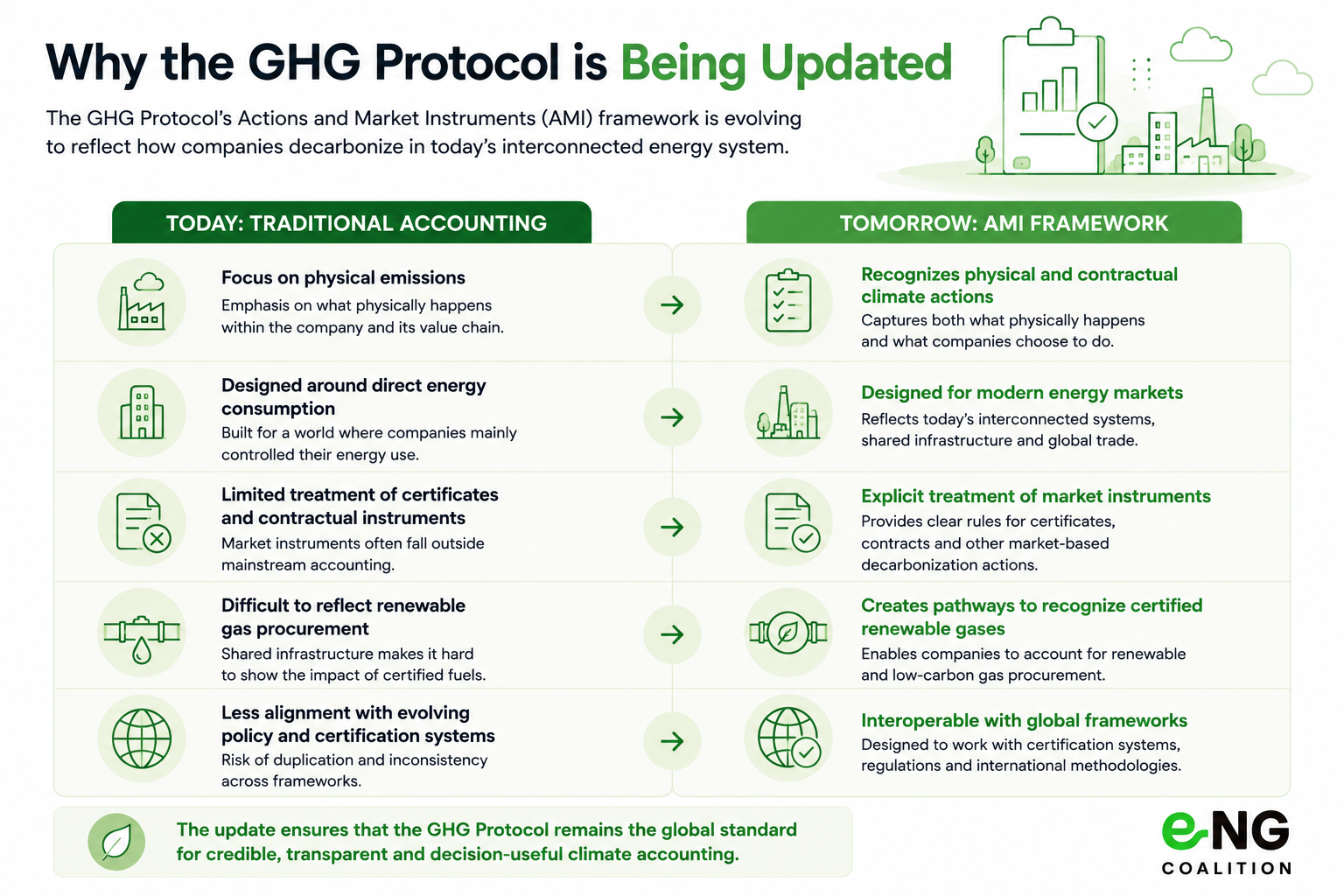
Yet the energy system has changed significantly since many of the Protocol's standards were first developed.
Renewable electricity markets have expanded globally. Certification systems have matured. Renewable and low-carbon fuels are increasingly traded across borders. Companies are investing in long-term procurement contracts, certificates, guarantees of origin, and other market-based instruments to support decarbonization beyond their physical operations. As a result, an important question remains: how should greenhouse gas accounting reflect climate actions that occur through contractual arrangements and certified environmental attributes rather than through direct physical delivery alone?
To address this challenge, the GHG Protocol has launched a major review process focused on Actions and Market Instruments (AMI), a new framework intended to modernize how companies account for climate actions in increasingly interconnected energy markets. For renewable gases, the outcome of this process could shape investment decisions, market development, and corporate procurement strategies for years to come.
Carbon accounting is often perceived as a reporting exercise. In reality, it has become one of the most powerful market-shaping tools in the energy transition. The way emissions reductions are measured and recognized influences which technologies receive investment, which procurement decisions are rewarded, and which decarbonization pathways companies choose to pursue.
This reality has become more and more evident across international policy discussions. Monitoring, reporting, verification, and lifecycle accounting are now, central pillars of energy policy and as renewable fuel markets mature, accounting frameworks are no longer simply measuring climate action, but they are also helping determine where climate action occurs.
For renewable methane, this evolution presents both an opportunity and a challenge. A robust accounting framework can create confidence for investors, facilitate long-term offtake agreements, support project financing, and accelerate deployment. Conversely, accounting rules that fail to recognize renewable gas procurement may weaken demand signals, create uncertainty for market participants, and slow investment in technologies capable of delivering substantial emissions reductions.
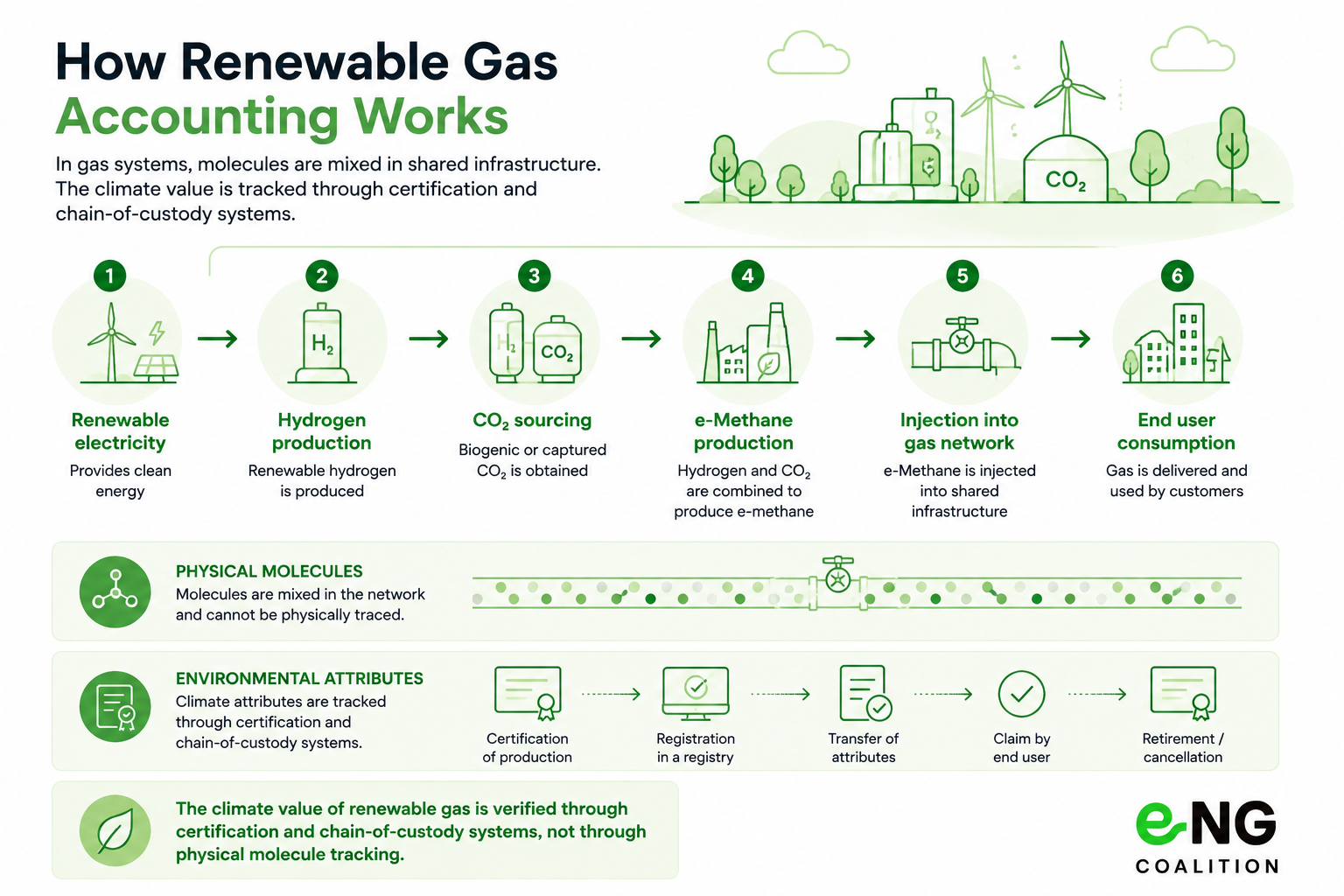
Unlike electricity, renewable gases move through interconnected infrastructure systems.
Biomethane, e-methane, and other renewable gaseous fuels are injected into shared gas networks, transported across borders, stored in existing infrastructure, and traded through established markets. Once injected into the system, it is often impossible to physically trace a specific molecule from production to final consumption.
Instead, environmental attributes are transferred through certification systems and chain-of-custody mechanisms that verify how a fuel was produced, its emissions performance, ownership transfers, and final certificate retirement. This approach is already widely used throughout energy markets. However, the future treatment of these contractual instruments within corporate greenhouse gas accounting remains under discussion.
For renewable gas producers and consumers, this is a critical issue.
If companies cannot reflect certified renewable gas procurement in their climate reporting, the value proposition of investing in renewable gas markets becomes significantly weaker. Climate benefits that are real, measurable, and verified may remain invisible within corporate reporting systems.
This challenge is particularly relevant for e-methane. Produced by combining renewable hydrogen with biogenic or captured carbon dioxide, e-methane is chemically identical to conventional natural gas but produced from renewable hydrogen and biogenic or captured CO2, giving it a fundamentally different climate profile. It can therefore be transported through existing gas grids, liquefied using existing LNG infrastructure, stored in existing facilities, and used in existing equipment without modification.
This infrastructure compatibility is one of e-methane's greatest advantages. It also means that accounting frameworks must be capable of recognizing environmental attributes across shared infrastructure systems and cross-border value chains.
In addition to the joint campaign submission, the e-NG Coalition filed its own standalone response focusing on e-methane-specific considerations.
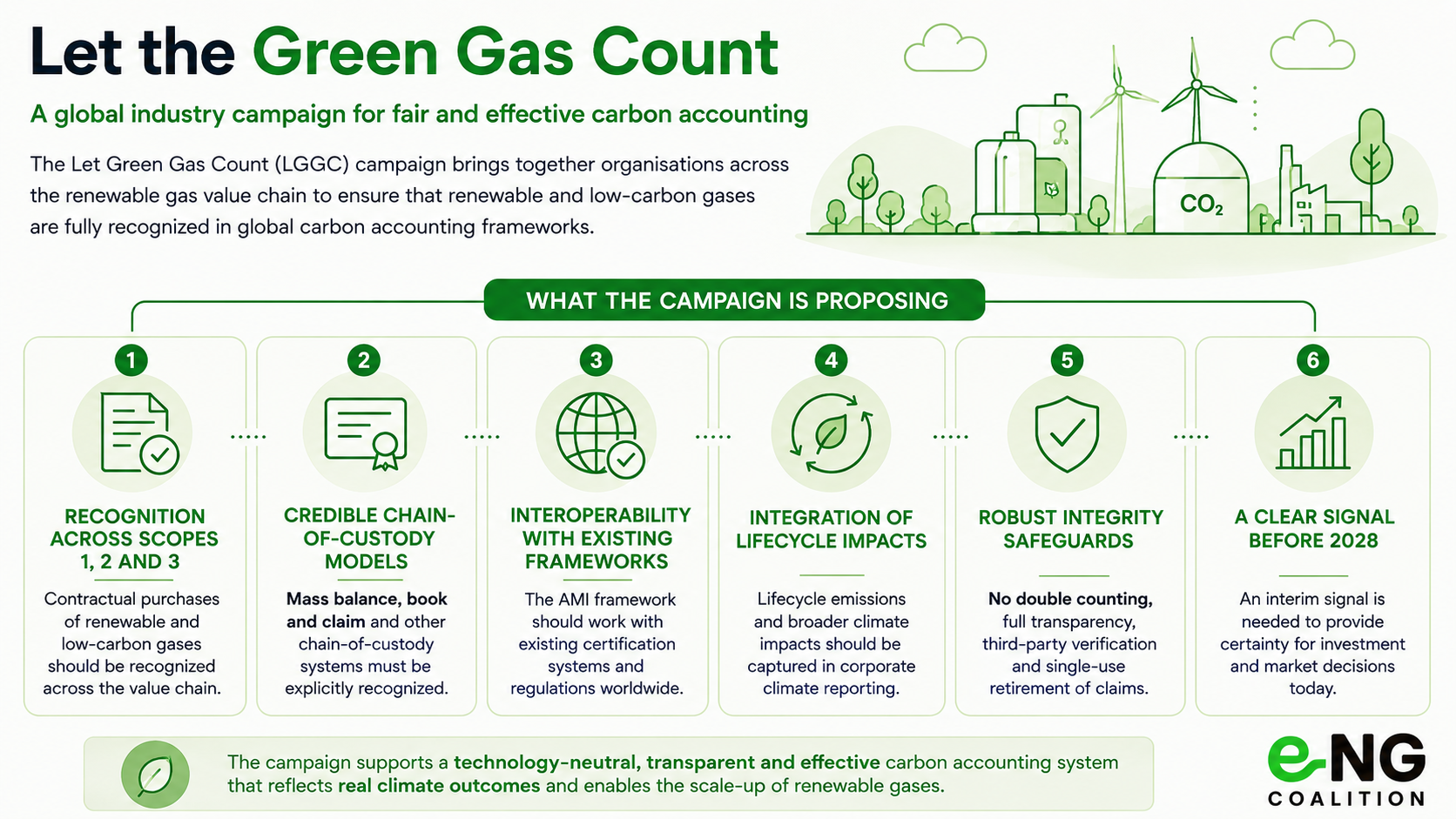
Recognizing the growing importance of greenhouse gas accounting for renewable gas markets, organizations across the sector have joined forces through the Let Green Gas Count (LGGC) campaign.
The campaign emerged from a shared concern that evolving carbon accounting frameworks could unintentionally overlook or disadvantage renewable and low-carbon gaseous fuels despite their contribution to emissions reductions and energy system decarbonization.
At its core, LGGC advocates for a simple principle: climate accounting frameworks should accurately reflect real-world climate outcomes and remain technology-neutral in how they recognize decarbonization pathways.
The campaign brings together stakeholders from across the renewable gas value chain and has become one of the leading industry voices engaging with the GHG Protocol reform process. Through technical submissions, industry sign-on letters, stakeholder engagement, and consultation responses, LGGC seeks to ensure that renewable gases remain fully integrated into future carbon accounting frameworks.
More specifically, the campaign advocates for:
For the e-NG Coalition, participation in LGGC is a natural extension of its broader mission to accelerate the deployment of renewable methane worldwide and ensure that regulatory and accounting frameworks evolve alongside technological progress.
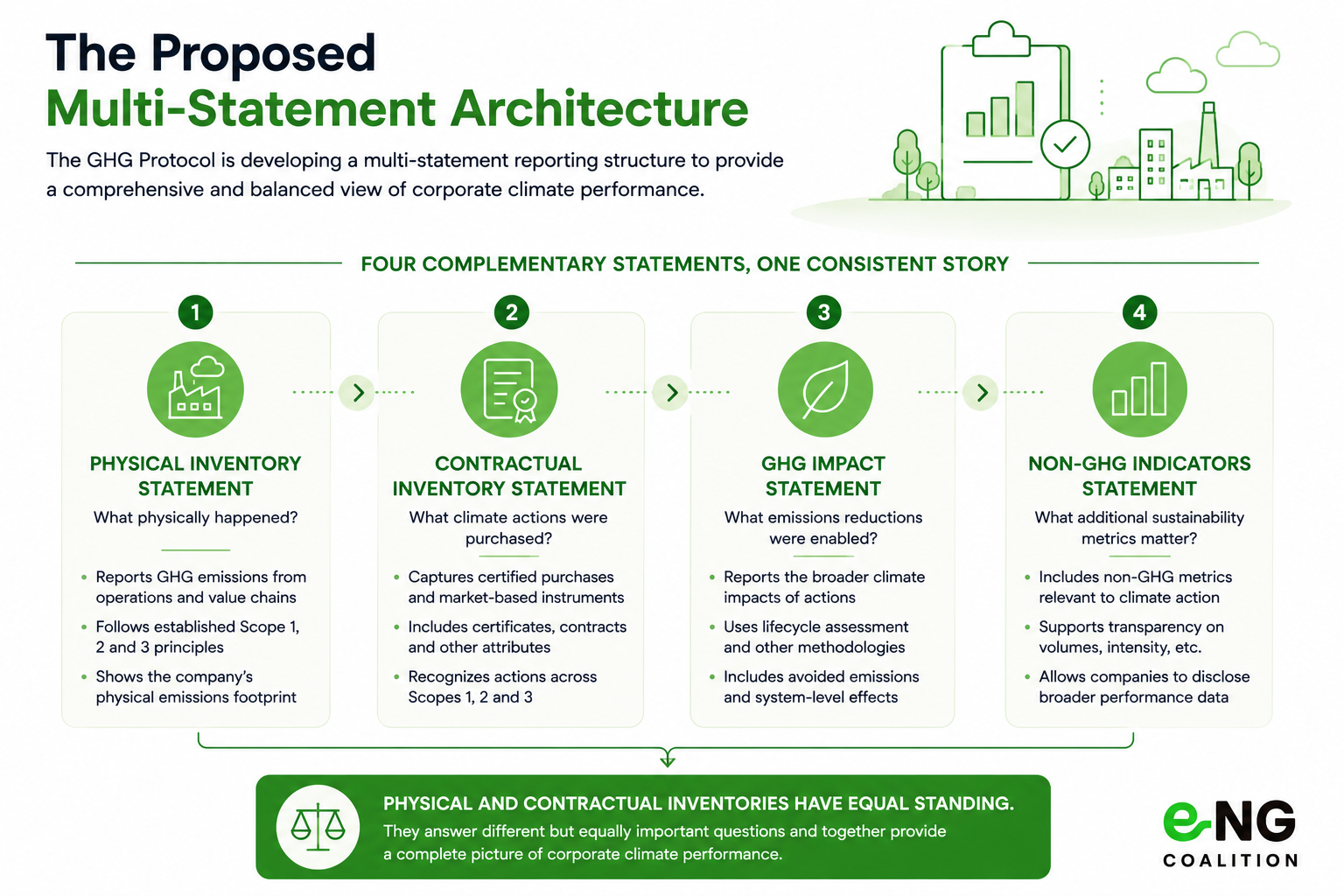
The current AMI review represents one of the most significant revisions of greenhouse gas accounting rules in recent years. The GHG Protocol is exploring a new multi-statement reporting architecture designed to better capture different dimensions of corporate climate performance.
The proposed structure includes:
The e-NG Coalition welcomes this direction of travel. For renewable gas markets, the introduction of a contractual inventory could create a credible accounting pathway for certified renewable gas procurement that cannot be adequately represented through a strictly attributional physical inventory.
However, we believe that an important principle must be preserved: the physical and contractual inventories should be treated as standalone, self-sufficient statements of equal standing, each answering a different but legitimate question.
They answer different but complementary questions. The physical inventory tells stakeholders what emissions physically occurred, and the contractual inventory reflects the climate actions and procurement decisions undertaken by the reporting entity. For renewable gases, both perspectives are necessary to provide a complete picture of climate performance.
A key priority for both the e-NG Coalition and the Let Green Gas Count campaign is ensuring that renewable and low-carbon gases can be appropriately recognized across all reporting scopes.
For industrial consumers, renewable gas procurement may contribute directly to Scope 1 emissions reductions when certified fuels replace fossil gas in industrial processes. For gas utilities and distribution companies, renewable gas procurement may play a role in Scope 2 accounting through certified gas supply systems. For producers, traders, shipping companies, and industrial supply chains, Scope 3 becomes particularly important.
Many of the most significant climate benefits associated with renewable gases occur across complex value chains, including upstream production, transport, distribution, and downstream fuel use. Restricting contractual accounting to only certain scopes would substantially limit the ability of companies to reflect these decarbonization actions and would weaken demand signals for renewable gas deployment.
The future framework must also recognize how renewable gas markets operate in practice. We believe the future framework must include robust integrity safeguards including prevention of double issuance and double claiming, mandatory certificate retirement, third-party verification, and transparent disclosure.
At the same time, the framework should remain principles-based rather than overly prescriptive. Renewable gas markets already operate within a growing ecosystem of certification systems and regulatory frameworks, including the EU Renewable Energy Directive, RFNBO rules, the Union Database, Japanese supply-chain criteria, US low-carbon fuel programs, and emerging International Maritime Organization methodologies.
The objective should be interoperability rather than duplication. The Coalition therefore supports explicit recognition of both mass-balance and book-and-claim chain-of-custody systems. Mass balance provides a practical solution for allocating certified renewable gas within interconnected gas networks. Book and claim can provide an additional mechanism for transferring environmental attributes across international value chains while maintaining robust safeguards.
We have also highlighted the importance of recognizing liquefaction-by-equivalence models, which are expected to play a central role in future cross-border e-methane trade. These configurations allow certified e-methane injected into a producing-region gas system to be matched with equivalent LNG exports destined for demand markets, creating a workable pathway for global renewable methane supply chains.
Another central theme of the debate concerns lifecycle emissions accounting. Renewable gas benefits often extend beyond direct emissions reductions at the point of consumption. They may include avoided methane emissions, displacement of fossil fuels, utilization of biogenic or captured carbon dioxide, and broader system-level impacts across industrial and maritime value chains.
Therefore, we support integrating lifecycle assessment methodologies within the future AMI framework and ensuring that the proposed GHG impact statement can adequately reflect these outcomes.
This is particularly relevant for maritime transport, where well-to-wake accounting frameworks are increasingly shaping regulatory and investment decisions. Clear interaction rules between contractual inventories and impact statements will be essential to ensure transparency while avoiding double counting.
Although the final AMI Standard is expected to be adopted in 2028, investment decisions are being made today. Across Europe, Asia, North America, and other emerging markets, developers are advancing first-of-a-kind e-methane projects, negotiating long-term offtake agreements, and seeking financing for large-scale renewable gas infrastructure.
The e-NG Coalition and the Let Green Gas Count campaign therefore believe that the market needs a stronger interim signal from the GHG Protocol. Providing greater clarity on the future treatment of renewable and low-carbon gaseous fuels would help reduce uncertainty, support investment decisions, and avoid project delays during the transition period leading up to adoption of the final standard.
The debate surrounding the GHG Protocol's AMI framework is ultimately about more than accounting. It is about whether carbon accounting systems can evolve alongside the technologies and markets they are intended to measure.
Renewable methane offers a unique pathway to decarbonization. It is infrastructure-compatible, scalable, land-neutral when produced through power-to-gas pathways, and capable of complementing electrification in sectors where direct electrification remains challenging.
For this potential to be realized, climate accounting frameworks must be capable of recognizing credible renewable gas procurement and accurately reflecting the climate benefits it delivers.
Through its engagement with the Let Green Gas Count campaign and its direct participation in the GHG Protocol consultation process, the e-NG Coalition will continue working to ensure that future accounting frameworks remain transparent, technology-neutral, interoperable, and fit for the realities of a rapidly evolving energy system.
----------------------------------------------
For more information, contact Mariana Tostes at mariana.tostes@eng-coalition.org
.jpg)
.jpg)
.jpg)