
.jpg)
When the e-NG Coalition published its founding manifesto two years ago, it made a simple but powerful case: decarbonizing the world's energy systems didn't have to mean starting over. The existing gas infrastructure is not an obstacle to the energy transition, but it may be the path through it.
Our manifesto introduced electric natural gas (e-NG) as a carbon-neutral fuel capable of decreasing carbon emissions in the global energy system without requiring the costly, disruptive overhaul that alternatives demand. As that vision continues to gain traction, this document remains one of the clearest articulations of why synthetic methane deserves a central place in the energy transition debate.
Electric natural gas (also known as e-methane or synthetic methane) is a carbon-neutral synthetic gas produced by combining renewable hydrogen with CO2 through a process called methanation. The carbon used in this process can be sourced from biogenic streams, or atmospheric capture technologies such as Direct Air Capture offering the strongest long-term carbon-neutrality profile and that point-source industrial CO₂ is a transitional bridge. Because this carbon is reused rather than newly emitted, the resulting fuel maintains a neutral carbon balance across its lifecycle.
.jpg)
What makes e‑NG particularly powerful is its chemical equivalence to conventional natural gas. This means it can be transported, stored, liquefied, and consumed using the same global infrastructure that has been built over more than a century. From long‑distance pipelines and LNG terminals to industrial furnaces and household boilers, every component of today’s gas system can handle e‑NG without significant modifications. This compatibility dramatically accelerates deployment and reduces transition costs.
This compatibility also underpins the concept of liquefaction by equivalence, an increasingly important mechanism for scaling renewable methane within interconnected LNG systems. Because e-NG is chemically identical to fossil natural gas, renewable methane injected into the gas grid can be credibly linked to LNG volumes liquefied elsewhere in the same interconnected system through robust mass-balance accounting. This approach enables the use of existing liquefaction and export infrastructure without requiring dedicated renewable-only facilities, reducing costs, accelerating deployment, and supporting the emergence of a global market for renewable LNG (e-LNG).
.jpg)
The global natural gas network includes millions of miles of transmission and distribution pipelines, extensive underground storage, and a mature ecosystem of import and export terminals. Central to our argument is that e-NG avoids the stranded-asset problem. Unlike pure hydrogen or ammonia, e-NG requires no new downstream infrastructure. E-NG can flow through this system immediately, avoiding the need for new infrastructure and preventing the stranded-asset risks associated with fuels that require dedicated supply chains.
The system’s readiness also reduces economic disruption, which is a fact that translates into significant cost and time savings and minimizes the social friction that typically accompanies large-scale energy transitions. Rather than asking industries and households to immediately adopt unfamiliar fuels and equipment, e-NG allows for a gradual, affordable ramp-up, blending into the existing gas supply at whatever ratio the market demands.
Because it fits into existing systems, e-NG can reach international markets faster than fuels that require new technologies or distribution networks. This speed is essential for meeting near-term climate targets and ensuring a stable supply of clean energy during the transition. As production scales, the cost of electrolysis, carbon capture, and methanation is expected to fall significantly, positioning e-NG as one of the most competitive renewable fuel pathways for global markets.
E-NG plays a strategic role in stabilizing renewable-based power systems. Surplus renewable electricity, often curtailed due to grid constraints, can be converted into renewable hydrogen and then into e-NG. This process transforms intermittent electricity into a storable, dispatchable molecule that can be used across sectors.
In addition, e-NG can be stored in existing gas infrastructure, including pipelines, tanks, and salt caverns, enabling long-duration and seasonal storage. It can then be used for electricity generation in gas turbines, for renewable heat, or as a fuel for mobility. This flexibility strengthens the resilience of renewable energy systems and supports the expansion of wind and solar capacity.
Countries around the world are integrating e‑NG into their long‑term decarbonization plans and the case for scale is reinforced by national policy ambitions already in motion. For example, Japan’s Gas Industry’ Carbon Neutral Challenge 2050 roadmap explicitly targeted 1% of national gas demand supplied by e-NG by 2030, rising to 90% by 2050, with a goal of reaching LNG price parity by mid-century.
In the United States, the Inflation Reduction Act of 2022 created new incentives for clean hydrogen investment, and the Department of Energy’s Hydrogen Shot initiative set a target of reducing the cost of clean hydrogen to $1 per kilogram within a decade.
In the European Union, e-NG produced in compliance with the RFNBO delegated acts qualifies under the Renewable Energy Directive. These policy signals clearly point towards a global market that e-NG is uniquely positioned to serve.
IMO's net-zero framework now formally recognizing e-fuels including e-methane, the finalized RFNBO delegated acts, Japan's procurement steps, growing Asian buyer interest in certified renewable and low-carbon gas.
In our manifesto, we make a particularly strong case for e-NG in industries where electrification alone falls short, as for example, i) steel, cement, and glass manufacturing, ii) heavy-duty long-distance freight and iii) maritime transport. These sectors depend on high-temperature heat and energy-dense fuels that battery technology cannot yet economically replace. E-NG fills this gap and is positioned as a drop-in solution requiring no process to redesign.
On efficiency, we have also pushed back on the assumption that synthetic gas loses too much energy in conversion. Hydrogen production via electrolysis runs up to 72% efficiency; methanation adds another 90% with heat integration. When total cost from production to end use is factored in, including transport and distribution, e-NG outperforms competing hydrogen derivatives such as e-ammonia and e-methanol, thanks to its higher volumetric energy density and its compatibility with existing infrastructure.
.jpg)
One of the key elements in the manifesto is that e-NG is not a speculative bet on future science. It is built on three technologies:
.jpg)
.jpg)
.jpg)
Together, these three technologies create a strong platform for scaling up e‑NG production globally. Each is already demonstrated at comercial scale, and all are positioned to become progressively more efficient and cost‑effective as deployment accelerates and demand increases.
The e-NG Coalition was founded as a collaborative alliance of companies across the global energy value chain united by the belief that synthetic methane has a meaningful role to play in achieving net-zero.
Our work spans from technical studies to advocacy, knowledge sharing through member working groups, the development of aligned emissions accounting and certification standards, and building the international partnerships needed to grow a global e-NG market. The eight founding members were ENGIE, Mitsubishi Corporation, Osaka Gas, RWE, TES-H2, Tokyo Gas, Toho Gas, and TotalEnergies.
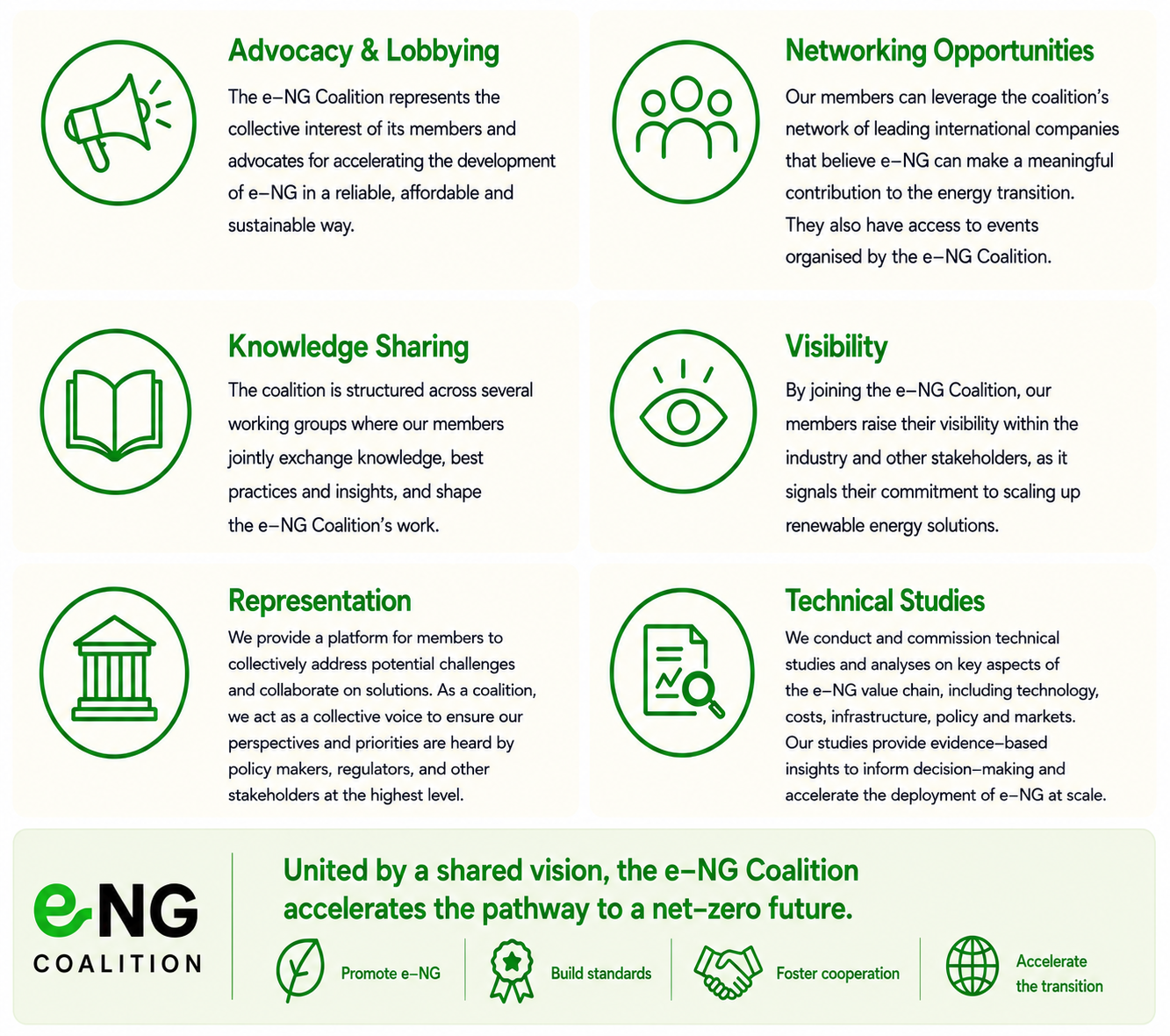
The Coalition remains open to new members who share its mission of scaling renewable gas solutions in a reliable, affordable, and sustainable way.
--------------------------------------------
For more information, contact Mariana Tostes, Communications Officer, at mariana.tostes@eng-coalition.org
.jpg)
.jpg)
.jpg)